7 Fast Facts About Thoroughbred Horses

By Zoë Randolph │Mental Floss│4 Min
Vermont FactsVermont FactsPauseNext video0:15 / 0:38SettingsVoltaxFull-screen
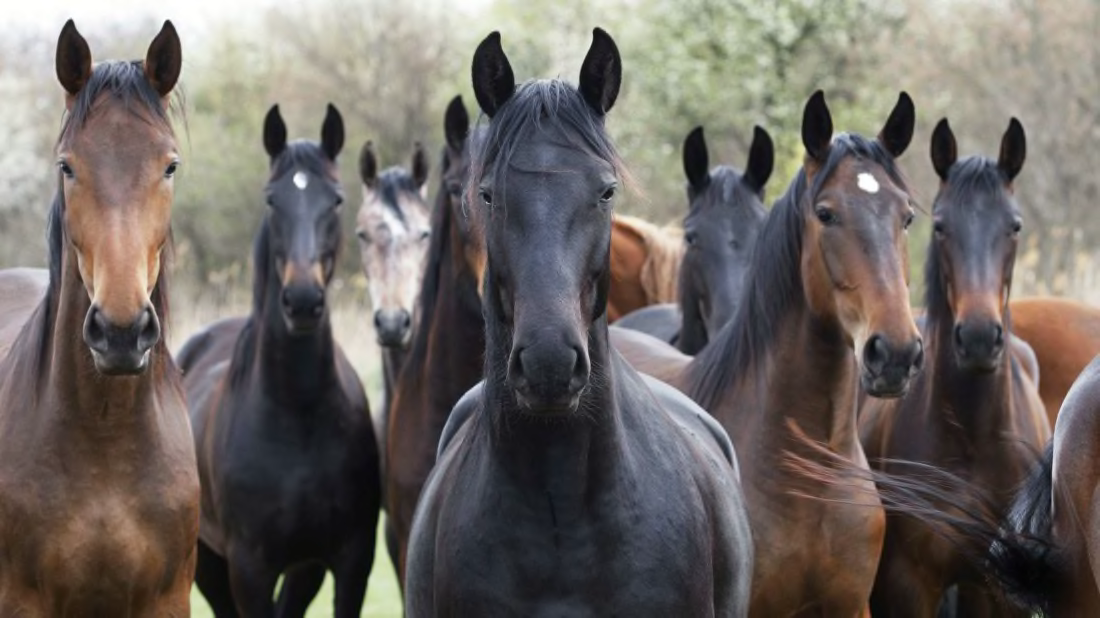
What did Secretariat, Man o’ War, and Seabiscuit have in common—besides great names? Each of these famed equines belonged to the same beloved breed: Thoroughbred. If you’ve ever caught the few fleeting minutes that comprise the Kentucky Derby, you’ve had a field full of Thoroughbreds on your screen.
Contrary to what the name might suggest, “Thoroughbred” doesn’t mean “purebred.” Thoroughbred is its own breed, and it’s one of the most highly prized in the world. Here are seven facts you might not know about these impressive horses.
1. PEOPLE HAVE BEEN BREEDING THOROUGHBRED HORSES FOR MORE THAN 300 YEARS.
The invention of the Thoroughbred can be tracked to England during the turn of the 18th century, when three stallions were imported from the Middle East and bred with strong, fast English mares.
To this day, every Thoroughbred can trace its lineage to one of these three sires, each of which was named for his owner: the Byerley Turk (owned by Captain Robert Byerley), the Darley Arabian (owned by Richard Darley), and the Godolphin Barb (owned by the Earl of Godolphin).
2. NEARLY ALL THOROUGHBRED HORSES SHARE A SINGLE COMMON ANCESTOR.

The most significant of the three foundational stallions was the Darley Arabian. The Arabian was a gift to Richard Darley from his brother, Thomas, who was working abroad as a merchant in Syria. Writing in 1840, James Christie Whyte, author of the exhaustive History of The British Turf, declared that the Darley Arabain’s arrival in England was an event that “forms the great epoch from which the history of the Turf should be dated.”
Whyte’s proclamation might sound dramatic, but modern science backs up his bold claim: A study conducted at Trinity College in 2005 concluded that 95 percent of modern male Thoroughbreds can call the Darley Arabian their shared great-grandfather.
3. THOROUGHBRED HORSES CAN RUN MORE THAN 40 MPH.
Thoroughbreds are known for their speed and stamina, clocking in at about 40 mph at their peak. The fastest recorded Thoroughbred speed came courtesy of a horse named Winning Brew, who hit almost 44 mph at a race in 2008. But while Thoroughbreds can sustain their speed, the title of fastest sprinter in the horse world belongs to the Quarter Horse, which can reach up to 55 mph.
4. ALL THOROUGHBRED HORSES CELEBRATE THEIR BIRTHDAYS ON THE SAME DAY.
Have a lot of Thoroughbred friends in your life? Don’t worry about keeping their birthdays straight. Every Thoroughbred—and all horses—in the Northern Hemisphere celebrate their birthday on January 1 (due to its opposite seasons, the Southern Hemisphere uses August 1). The simple explanation is rooted in convenience and weather: A universal date makes it easy to keep track of horses’ ages and allows them to become eligible for spring and summer events en-masse. But why New Year’s Day?

Just as the lineage of Thoroughbreds can be traced to England, we have the English to thank for this custom. From the mid-18th to mid-19th century, May 1 was the universal birth date for Thoroughbreds because it aligned with the beginning of the racing season. But after Britain changed its date to January 1 in 1858, the custom began to spread. Like so much in American life at the time, the debate over whether to follow the British example divided the country along geographical lines. Northerners embraced the move while southerners stubbornly refused to switch. In the years following the Civil War, the North became the center of American horse racing, and the January 1 date took hold once and for all.
5. ENGLISH RACERS ONCE TRIED TO BAN NON-ENGLISH THOROUGHBRED HORSES FROM BEING RECOGNIZED AS MEMBERS OF THE BREED.
In 1913, Victor Child Villiers, 7th Earl of Jersey, spearheaded a resolution in the English Jockey Club that sought to exclude nearly all Thoroughbreds bred outside of England or Ireland from the General Stud Book, which has served as the official record English Thoroughbred pedigree since 1791.
Named after the Earl, the Jersey Act was designed to protect English stock from the influx of American-bred Thoroughbreds arriving overseas after racetrack betting was outlawed in the U.S. at the turn of the 20th century. But the rule was short-lived: In 1949, after a series of French horses with “impure” American bloodlines won prestigious English races, the club moved to make the Jersey Act less restrictive.
6. THOROUGHBRED HORSES DO MORE THAN JUST RACE.
Thoroughbreds are bred for speed and endurance, with long necks and legs that make them well suited for the race track. But some Thoroughbreds are also used for other equestrian sports including steeplechase, polo, and eventing. Non-race uses are especially common when it comes to Grade Thoroughbreds (horses with a single Thoroughbred parent), which are used for hunting, polo, and pleasure riding. Plus, even racing Thoroughbreds’ careers aren’t over once they retire from the track. Some go on to compete in dressage, jumping, and hunting.
7. THE MOST EXPENSIVE HORSE EVER SOLD WAS A THOROUGHBRED.
If you were wandering around Ireland in the year 2000 with an extra $70 million dollars burning a hole in your pocket, you could have become the proud owner of Fusaichi Pegasus, a Thoroughbred stallion with an impressive highlight reel. After a two-year racing career that included a win in the Kentucky Derby and a second-place finish in the Preakness, the 3-year-old horse was put up for sale. Unfortunately for the Ireland-based Coolmore Stud farm, his breeding career proved less impressive than his racing one, and he retired from his stud duties in 2020.

You may also like

Poem vs. Sonnet: What’s the Difference?